Advertorial
My numb, burning feet almost made me quit the job I love. A client in my chair finally explained why.
Nothing is worse than the anxious thought of your neuropathy progressing, while nobody tells you how to work with what your feet have left. If your feet feel numb and on fire at the same time, if the tops of your feet hate every shoe you own, and if the only solution your doctor offers is a higher dose of gabapentin, read this before you buy another pair of "comfort" shoes.

Last spring I had a bride's mother in my chair, and halfway through her color I had to stop and hold the counter.
Not because I was dizzy. Because I couldn't tell where my feet were.
If your feet do this too, you already know what I mean. And you probably know the other half, the half nobody believes when you try to explain it.
My feet are numb, like I'm standing in two pairs of thick socks on a floor I can't really feel. And at the same time, they burn. Pins and needles all day, and every so often a little electric shock through my toes, so sudden I've flinched with scissors in my hand.
How can feet be too numb to feel the floor, and so sensitive that a sock seam hurts? I asked three different people that question. Not one of them could answer it.
I'm 50. I've done hair for 27 years, and my regulars have followed me through three salons. I always figured my hands or my back would be what slowed me down someday.
I never once thought it would be my feet.
And the person who finally answered that question wasn't one of my doctors. It was my 3 o'clock client on Thursdays, sitting in my own chair, halfway through her blowout.
I'll tell you exactly what she said. But first you need to know how bad it had gotten, because I have a feeling you're going to recognize a lot of it.
What I never told my clients
It started in my left big toe about two and a half years ago. A little buzz, like it had fallen asleep and forgot to wake up. I blamed my shoes. Then all the standing. Then it was both feet, then the balls of my feet, and some nights it crept up toward my arches.
That's what kept me up more than the pain. Not where it was. Where it was going. I'd lie there doing the math. If it's spread this far in two years, where is it in five? Am I still doing hair at 55? Will I even be able to drive to the salon?
Is this just my life now?
Mornings were the good part, and they weren't good. By my 2 o'clock, standing behind the chair felt like standing on hot gravel. I started blocking out ten minutes mid-afternoon as a "break" so I could sit down without anyone asking why.
I'd watch a client's teenage daughter run across the parking lot in flip-flops, not giving her feet a single thought, and feel this ugly little stab of jealousy. Jealous of a kid. For walking.
The shower was the worst. You close your eyes to rinse your hair and suddenly you have no idea if you're standing straight. I started washing my hair with one hand flat on the tiles. Me. A hairdresser, who can't wash her own hair without holding the wall.
Then bedtime. You'd think lying down would help. But the second my feet were still, the tingling would start up like it had been waiting all day for me to stop moving, and even the sheets on the tops of my feet drove me nuts. This left me keeping my feet out from under the covers. Fan pointed at the end of the bed. Asleep around 1AM, awake at 3AM. Then waking up to a full book of clients on four hours of sleep.

And I couldn't stand shoes anymore. The tops of my feet hated every pair I owned. Anything that hugged my foot felt claustrophobic within the hour, and some days my socks felt bunched up under my toes when they were perfectly flat. By lunch I wanted to rip them off.
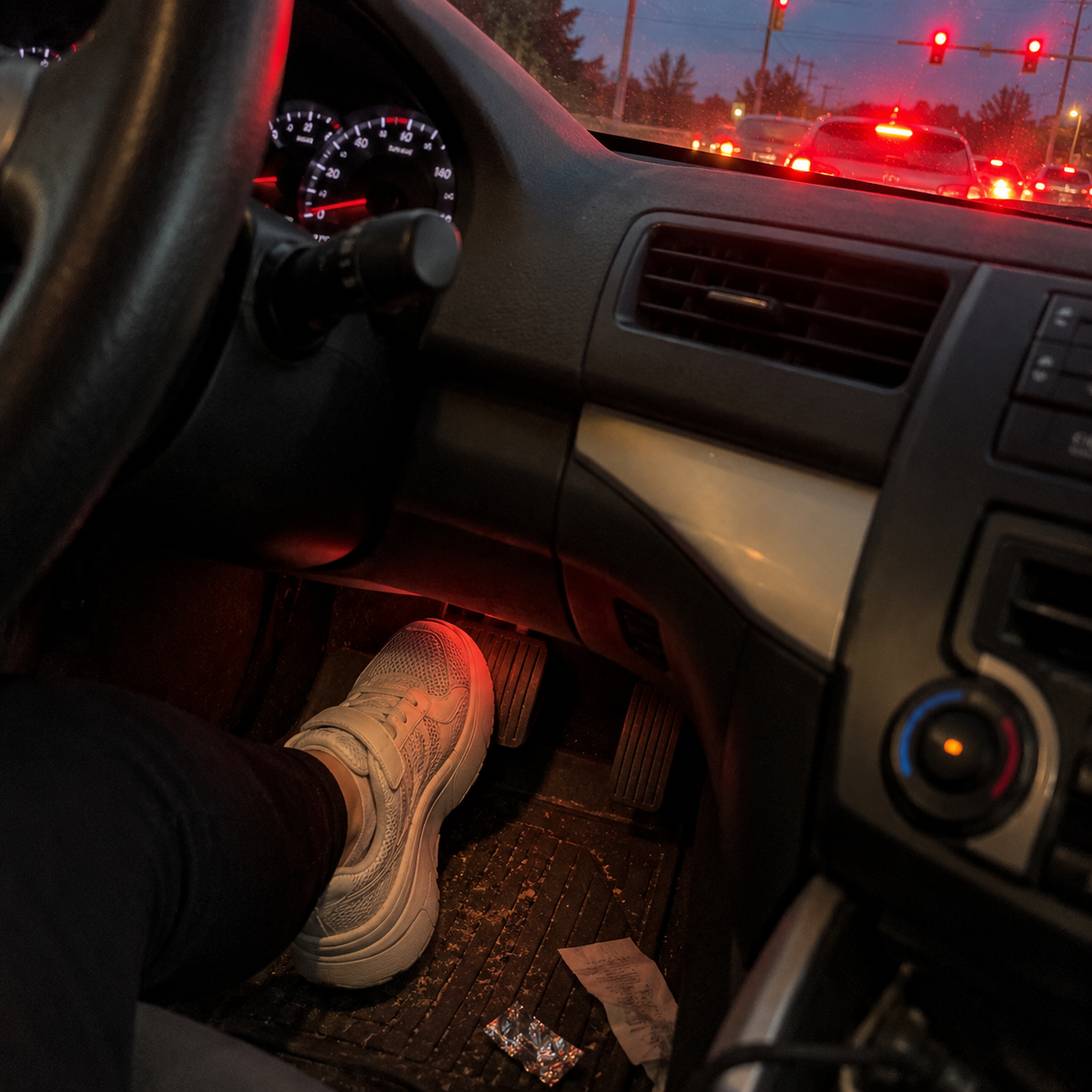
The one that scared me was driving. At a red light I couldn't feel how hard I was pressing the brake. I'd stare at the bumper in front of me like a hawk, making sure we weren't creeping forward.
Remember that red light. It's my favorite part of this whole story.
My girlfriends do a dinner every month. I started finding reasons not to go, and it wasn't even the pain, exactly. It was the planning. Will there be a railing on the stairs? Will we be standing at the bar waiting for a table? Is there a counter I can lean on without it looking weird? Just thinking it through made me tired enough to stay home.
This was not what I pictured 50 looking like.
And I thought I was doing everything right. Softer shoes. More cushion. Whatever the neuropathy websites said to buy.
What I didn't know yet was that those thick, cushiony shoes were part of the problem. They were one of the reasons I couldn't feel the floor behind my chair. One of the reasons the brake felt like nothing under my foot. Maybe even part of why every restaurant staircase scared me.
Nobody told me that. Not my doctor, and definitely not the man at the shoe store who happily sold me a second pair.
Third increase, same answer
My doctor is a kind man. He's also the reason I'm on my third increase of gabapentin.
They ran every blood test. They did the nerve test where they shock your legs. Nobody could tell me why it started, and every visit ended the same way. I'd describe the burning, the shocks, the shower, and he'd nod and say it's neuropathy, it may or may not progress, let's go up a little on your dose and see.
The pills take the edge off at night. They also leave me foggy at work, which is not ideal when you're holding a razor next to someone's ear.
And sure, the pain eases, but what nobody did was tell me how to live with what I've got left. How to stand for a living on feet I can only half feel. Wait a few months and see. Bigger number on the bottle. Come back in six weeks.
So I became my own research department. Reddit at midnight. Magnesium. Alpha lipoic acid. A $40 cream that smelled like a gym bag. Compression socks that made my feet feel strangled. I'm not knocking anyone those things help. They just didn't help me, and I was getting so tired of trying things.
And one question I couldn't shake. If this is the third increase, where does it end?
"Honey, what shoes are those?"

The day it changed was a Thursday. Carol, my 3 o'clock client, retired a few years ago after 30-some years as a physical therapist. She'd watched me shift from foot to foot through her whole haircut, and when I sat down on my stool to do her blowout (yes, I'd started doing blowouts sitting down), she asked what shoes I had on.
I showed her. Big, soft, thick-soled walking shoes. The kind every website tells you to buy for neuropathy.
And then, I don't know why, it all came out. Maybe because she was the first person in two years who asked about my feet like she actually wanted to know.
I told her about the numb and the burning, and washing my hair holding the wall. I told her I'd been skipping dinners with my girlfriends, which I hadn't even admitted to my sister. And then I said the thing I hadn't said out loud to anyone. "I'm scared I won't be doing this in five years. This chair. My clients. All of it."
My voice cracked on "all of it." In front of a client. With her hair half dry.
Carol didn't look surprised by a single word. She just nodded, like she'd heard every bit of it before. Later she told me she had, from more patients than she could count.
That was the first time in two years I didn't feel crazy.
She made a face. Then she asked me something that stopped me with the dryer in my hand.
"Tell me something. At home, in just your socks, can you feel the floor better than you can in those?"
I could. I'd noticed it for months and never thought twice. At home in socks, I could sort of feel where my feet were. Put on my "good" shoes, and the floor went away.
"That's because your feet aren't short on padding, honey," she said. "They're short on information."
Too quiet and too loud at the same time
She explained it in about two minutes. It was the first explanation that made sense of all of it at once: the numb and the burning, the shoes and the brake. Here's how she put it.
Your feet and your brain talk through thousands of tiny nerves. Normally the messages are clear. The floor is hard. There's a little pressure on your toes. You're standing straight.
Neuropathy damages that line. And it breaks in two directions at once.
Some messages stop getting through. That's the numbness, the thick-sock feeling, the floor that seems far away.
Other messages come through as static. Loud, painful static. That's the burning and the shocks, even when nothing is touching you.
Like a radio with damaged wiring. Too quiet when you need it, too loud when you don't.

I actually laughed, because that is exactly what it feels like. And the question nobody could answer suddenly made sense. My feet weren't contradicting themselves. The numb and the burning were the same broken line.
Then she got to shoes, and I stopped laughing.
When the nerves are that touchy, she said, it isn't really the amount of pressure that hurts. It's how the damaged nerves read it. So a shoe pressing on the tops of your feet and squeezing your toes all day just keeps feeding the static. That's why the tops of my feet hated everything I owned.
And those big, soft, thick soles? They turn the volume down on everything. Including the little bit of signal my feet still had. Which is why I couldn't feel the floor behind my chair. And why I couldn't feel the brake.
I'd been wrapping feet that were already starving for signal in another inch and a half of foam.

I wasn't doing anything wrong. I'd done exactly what I was told. It just happened to be solving the wrong problem.
Which left one obvious question, and I asked it out loud: so what am I supposed to wear?
Her answer surprised me. It wasn't a brand. It was one rule she gave every patient with neuropathy before they changed a single thing about their shoes. If I'd known it two years earlier, I'd have saved myself a closet full of mistakes.
The one rule she gave every patient
"Turn down the static. Keep the signal. And let your feet set the pace."
Not more cushion. Not "go barefoot" either. The bit in between.
In real life, she said, that comes down to a few plain things:
- Room. A wide, foot-shaped front so nothing squeezes your toes, and a soft upper that doesn't press on the tops of your feet. That's the static turned down.
- A thin, flexible sole underneath, so the ground can actually reach you. That's the signal kept.
- Protection you can take away a little at a time. Enough at the start that touchy feet aren't overwhelmed, then less, as they get used to it. That's your pace.
That last one matters most with neuropathy. Put numb, sensitive feet in flat barefoot shoes overnight and you're asking for sore feet, or worse. "You want a volume knob," she told me. "Not an on-off switch."
Then she said the thing that actually got me.
"Everybody's neuropathy is different. That's why nobody can hand you the perfect shoe. The only shoe that makes sense is one you can adjust to yours."
If you've spent any time in the neuropathy groups, you know that's the one thing we all agree on. Everyone is different. What saves one person does nothing for the next. It's why every "best shoe for neuropathy" list felt useless to me. And here was the first idea I'd heard that took that seriously instead of ignoring it.
She said she only knew of one shoe that came with the knob built in.
I wrote the name on the back of an appointment card. That night I spent two hours on my couch trying to prove her wrong.
Two hours trying to prove her wrong
I didn't believe her right away. You probably wouldn't either.
That night I added it up. In two years I'd spent around $480 on shoes that were supposed to help. Hokas that burned the tops of my feet by lunchtime. Skechers slip-ins that felt fine in the store and claustrophobic by my second client. A pair of "diabetic" shoes that looked like something my grandmother wore, and still rubbed. (I'm 50, not 90. I still want to look like me at work.)
Barefoot shoes looked even worse at first. Most were made for young runners. The rest came with one paper-thin sole and a little warning to "transition slowly." No way to actually do that. Just go slow, and good luck.
That's the thing nobody says about barefoot shoes and neuropathy. The idea makes sense. Jumping straight in doesn't. And almost none of them were made with feet like ours in mind.
The volume knob, in a shoe

The shoe Carol pointed me to is the Mettle Relief Alpha. Going down her list, it was all there:
- A wide, foot-shaped toe box, so my toes spread out instead of getting squeezed. Static down.
- A soft knit upper that doesn't push on the tops of my feet. Static down.
- A thin, flexible, flat sole, so I could feel the floor under me again. Signal kept.
But the part I haven't found anywhere else is in the box: transition insoles.
They're cushioned layers that sit inside the shoe and give your feet extra protection at the start. You wear them while your feet get used to everything. When you're ready, you take them out and let more of the ground through. Bad week? You put them back in.

Your feet decide. Not a website, and not a warning on a label.
That's the volume knob. Mettle just put it in the box. And since your neuropathy isn't the same as mine, that's the whole point. You start where your feet are.
I ordered a pair that night, half so I could tell Carol the next Thursday that she was wrong.
That isn't how it went.
A bad Wednesday, a quiet Thursday, and that red light
I wore them around the house the first weekend, insoles in.
Day one felt odd. Flat. Roomy in a way my feet didn't know what to do with. My calves noticed by the evening, the "put to work" kind of tired, not the hurt kind.
Near the end of that first week, something small happened at work. I was standing behind the chair doing a long balayage, and I realized I'd shifted my weight without reaching for the counter. My feet had told me where they were. Not loudly. But they'd told me.
Week two was rough, and I won't pretend it wasn't. I had a bad flare on the Wednesday and very nearly went back to my old shoes. Instead I just left the insoles in a few more days than I'd planned. That's what they're there for.
Somewhere in week three, I stopped taking my shoes off in the back room between clients. I didn't decide to. I just forgot to.
When Carol came in that Thursday, I stood behind her for the whole cut. She noticed before I said a word. She didn't say anything either. She just looked down at my feet, then up at me in the mirror, and raised her eyebrows.
And then, the red light. On the way home, sitting at the light by the pharmacy, I could feel the brake. The actual pedal, under my foot. I sat through half a second of green just feeling it. (The man behind me was not impressed.)

My feet aren't fixed. Neuropathy doesn't work like that, and anyone who tells you otherwise is selling something. I still get burning some nights. I still sit for blowouts on long Saturdays. The gabapentin is still in my cabinet.
But my shoes stopped adding to it. And getting a little signal back changed more than I expected.
Last month my sister visited and we did the farmers market, the one with the long steps down to the river. Halfway down she turned around and said, "You're not holding the rail." I hadn't noticed.

A client asked me where I got my shoes. A client. Asking about my shoes. Nobody had done that in years.
And two Fridays ago, I went to girls' dinner. I didn't look the restaurant up for stairs first. I stood at the bar with a glass of wine for twenty minutes waiting on our table, laughing at something my friend Deb said, and it was only on the drive home that I realized I hadn't thought about my feet once all night.

That's all I wanted. Not a miracle. Just a few hours where my feet weren't running my life.
If you're where I was
Here's what I'd tell you if you were sitting in my chair.
Tonight, try what Carol had me do. Stand at your kitchen counter with one hand on it, in socks. Notice how much of the floor you can feel. Then put on the shoes you wear most and do it again.

If the floor goes quiet in your shoes, then you already know what I didn't. Your feet aren't short on padding. They're short on information.
And if that's you, here's the simple math. The Relief Alpha is $69.95 right now, down from $140, and the transition insoles, which sell for $38 on their own, come free with it. That's less than a single pair of the shoes sitting in my closet that I'll never wear again.
I ended up with two pairs. One lives at the salon, one at home, and the second pair is cheaper in the bundle.
What made it easy to say yes, after being burned so many times, was the 100 days. Wear them at home first. Go at your own pace. Keep the insoles in as long as you need. And if your feet don't agree, send them back. You're not betting another hundred dollars on another closet shoe. You're spending a few evenings at home in new shoes.
If I were starting again, this is how I'd do the first few weeks:
- Week one: insoles in, around the house, an hour or two. Your calves will notice. That's normal.
- Weeks two and three: insoles in for work days. If a flare hits, don't push. That's exactly what the insoles are for.
- When they feel like nothing: take the insoles out for an hour at home and notice what the floor feels like.
One more thing, because Carol made me promise to say it. If you have diabetes, or spots on your feet where you wouldn't feel a blister or a cut, talk to your podiatrist before you change shoes, and check your feet every night. Getting signal back is good. Unprotected feet are not.
Or you can do what I did for two years. Buy a softer pair, wait for the next increase, and keep planning your life around railings. I know how that goes. I wouldn't wish it on you.
I won't tell you this works the same for everyone. Neuropathy is different for every one of us, which is exactly why I trust a shoe that lets you start where you are. I can only tell you that last Saturday I stood through ten clients and drove myself home feeling the brake.
That was enough for me to sit down and write all of this out.
Lori
P.S. If you take one thing from this: start with the insoles in. Take them out when your feet say so, not before. And put them back if your feet ask.
P.P.S. If you've got a shoe graveyard like mine, this is the one you can send back if your feet disagree. Try the kitchen-floor test first. It costs nothing.